Located in the beautiful wilderness surrounding Spirit Lake, Idaho, is the studio of Western and wildlife artist Joe Kronenberg. It was here in this pristine land where my life intersected with a father and son, all within the framework of Western art.
The backstory that is woven through this story, a backstory that deserves sunlight here, is this: Joe Kronenberg is the son of an old comrade in arms, a dear friend this writer had not seen since the 1960s when we served together in Vietnam, in Marine Corps Helicopter Squadron HMM361.
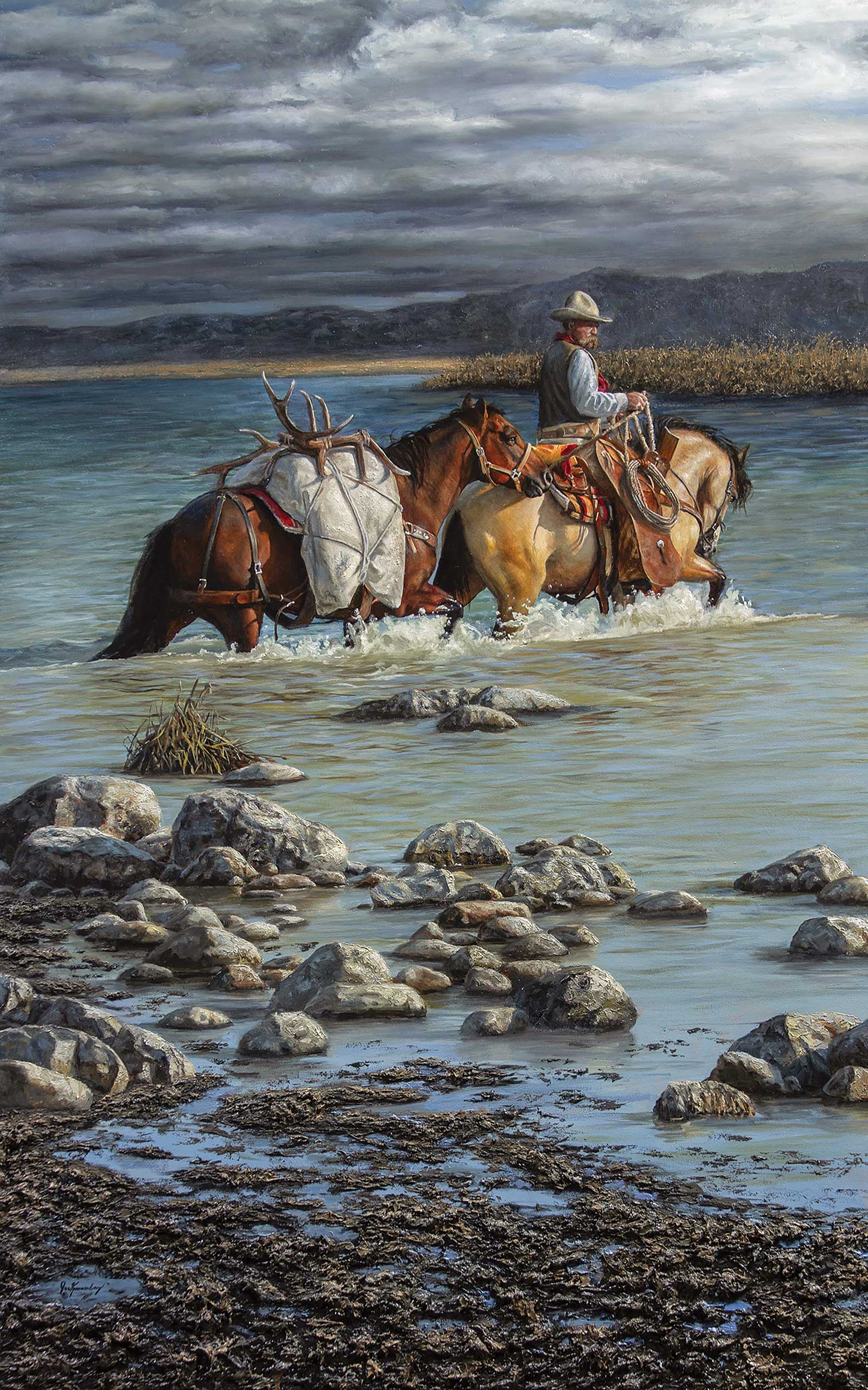
Headed Home, oil on board, 48 x 30 in.
Several years ago, while driving Highway 95 up the Idaho Panhandle, signage pointed out that the studio of Western artist Joe Kronenberg was in nearby Spirit Lake. Seeing this, an epiphany followed. My old friend had joined the Corps in Spokane, Washington, 40 minutes from Spirit Lake, and his name was also Joe Kronenberg. With this, my thoughts began to run wild.
The question that immediately came to mind was, “Might these two Joe Kronenbergs be related? Was my old Vietnam vet buddy the father of this acclaimed Western artist?” Calling the gallery in Spirit Lake, it was as suspected. They were father and son, and with the help of his son Joe, I would see my friend one last time, shortly before he left us.

Joe Kronenberg
But the story does not end there. Fast forward to 2025. As a photojournalist, story ideas often pop. It’s like being hooked up to a telegraph. Such was the case when the billboard I saw several years earlier took possession of my thoughts. And as I ruminated about this, I became more curious about Joe Kronenberg the artist, who I had never met. I wanted to understand why his name today is discussed among collectors and aficionados of traditional Western and wildlife art. Why is it this artist has been invited for two consecutive years to enter a painting in the Coeur d’Alene Art Auction in Reno, Nevada? Why is it that his work is represented at some of the top Western galleries in the country? How did he develop his skill as a painter? I was searching for answers. Suffice it to say I was not disappointed, nor will you be.
Old School
Kronenberg’s oil paintings reflect a subtle but firm linkage with evolutions that took place in the art world during early and mid-19th century America. This was a period in American history when the words “Westward Ho” were on the tip of everyone’s tongue. With the United States heading west, vast expanses of land acquired through the Louisiana Purchase and Mexican American War were being settled. And corresponding with this march west were changes taking place among American artists and how they were rethinking techniques, composition and content.
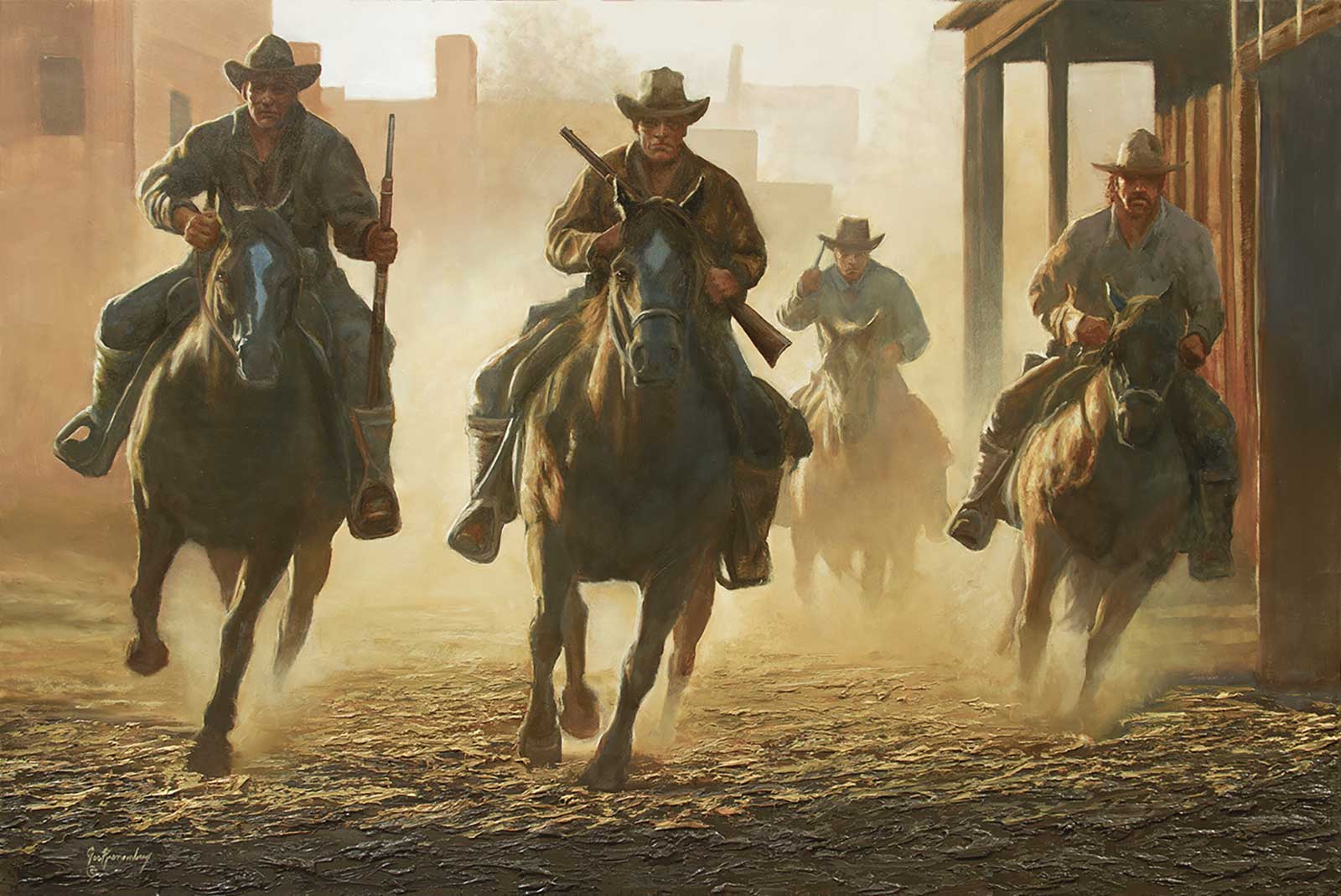
Dust Storm, oil
As a student of art, Kronenberg understands these 19th-century philosophical evolutions. Of paramount importance was the Hudson River School, with its newfound appreciation for the beauty of nature, wildlife, landscapes and the principles of luminism and tonalism. Influenced by romanticism of late-18th century Europe, the Hudson River School’s treatment of light played a fundamental role in this philosophical shift. Kronenberg’s oil paintings reflect an intimate appreciation of these old school principals. Another evolution shaping how he uses oil paints occurred four centuries ago, with 17th-century Dutch painter Rembrandt. More on this momentarily.
Kronenberg views Western art through a traditional 19th-century metaphysical prism, and he’s not alone. In America today there are many who look in the rearview mirror and embrace those 50 years in the American West, specifically the half century following the Civil War. This was a period when good and bad, right and wrong, weak and strong were not seen simply as shades of gray.
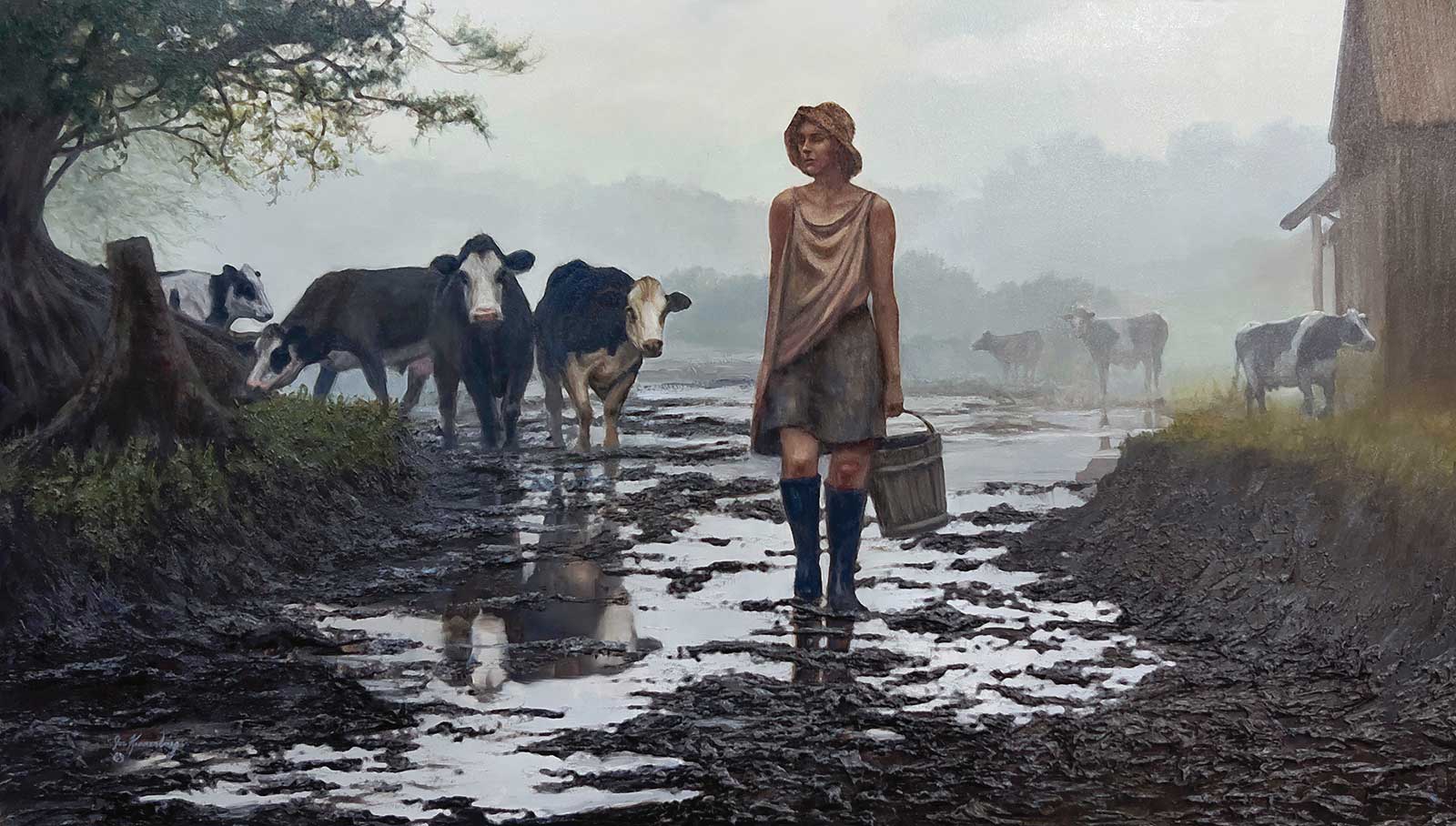
Farm Girl, oil
Add to this love of nature’s beauty, of wildlife, admiration for rugged individualism, and the idea that the individual is basically good but becomes corrupted when crammed and jammed together. All are baked into the culture we call the American West. These revered principles are evidenced in Kronenberg’s oil paintings. They find their way into his brushstrokes and onto the canvas. And as for avant-garde machinations that routinely occur in Western art, Kronenberg sees these as forms of Pop Art.
His commitment to traditional painting and his passion for the Western lifestyle is something he does not keep under lock and key in his Spirit Lake studio. No, in the art classes he teaches and guest appearances he makes, he unabashedly makes his philosophy known. And should he ever choose to ever write a mission statement, no doubt it will say he intends to keep it that way.
Self-Taught
Kronenberg traces his passion and aptitude for art back to the second grade. After high school he poked around at a formal education in the arts, but the structure and narrow channeling left him feeling stifled. Instead, he used his curiosity and imagination as compass and sextant to navigate unchartered but exciting waters.
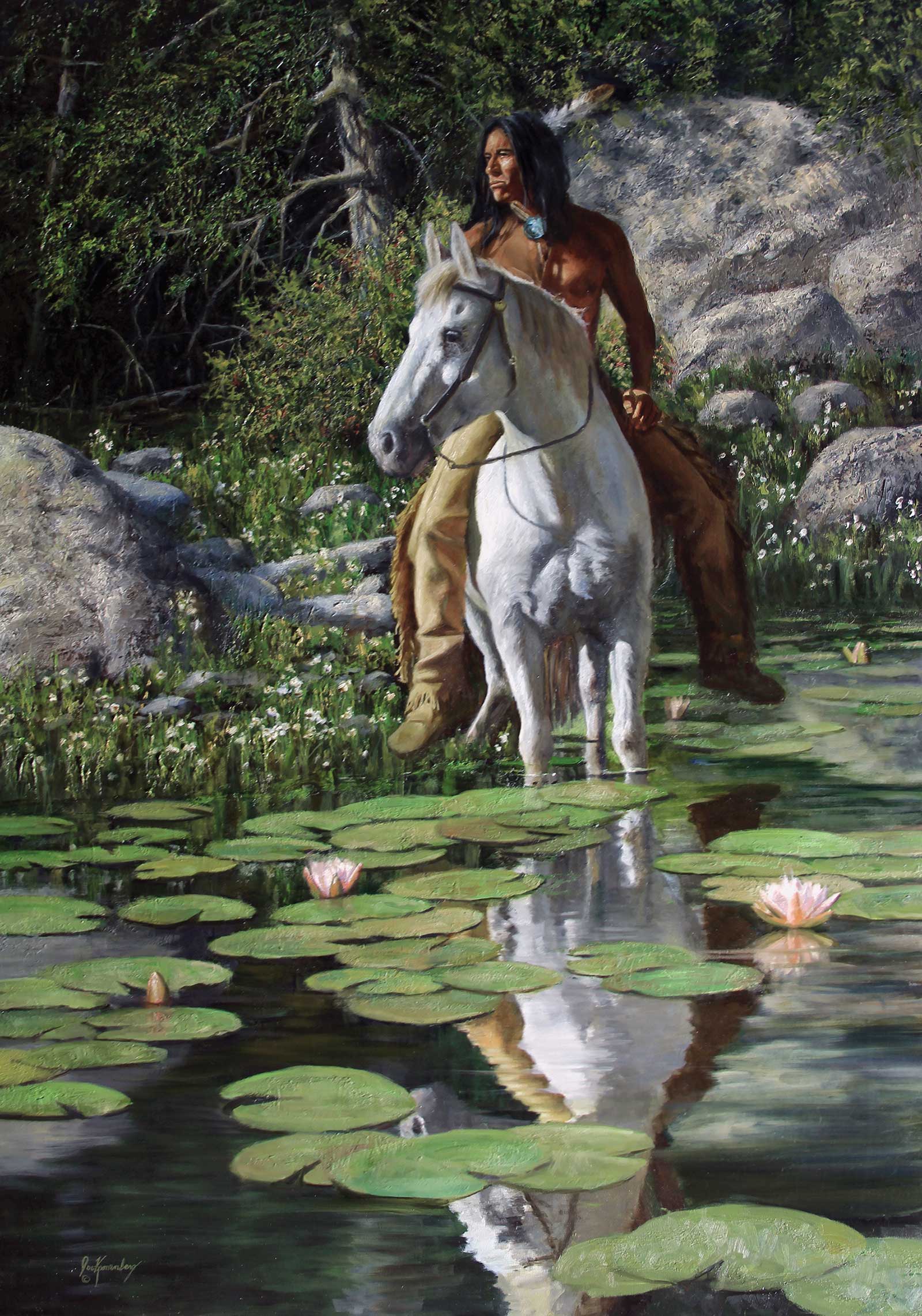
Serenity, oil on board, 42 x 30 in.
Now leap forward several decades to nearly 2000. The artist is 35 years old. With a large, blended family, kind of like the Brady Bunch, and with the century clock about to strike 12 as the new millennium draws near, Kronenberg is successful and on the fast track in corporate America. However, burning in his belly is the fire kindled when he was a youth. He knows first and far most he is an artist, and he knows if he is going to make it in the art world, he must do so before he turns 40.
With six months of living expenses saved, he promises his family that if their bank balance ever drops to a three-month reserve, he will give up his crazy dream and find a job. With their blessing he jumped into the deep end of the pool, never to look back. Initially painting wildlife, he transitioned into Western art, which now represents most of what he paints. Featured in shows, galleries and art auctions, his pool of repeat clients is substantial, as are new commissions. His paintings are found in France, New Zealand, Australia and in private collections across North America.
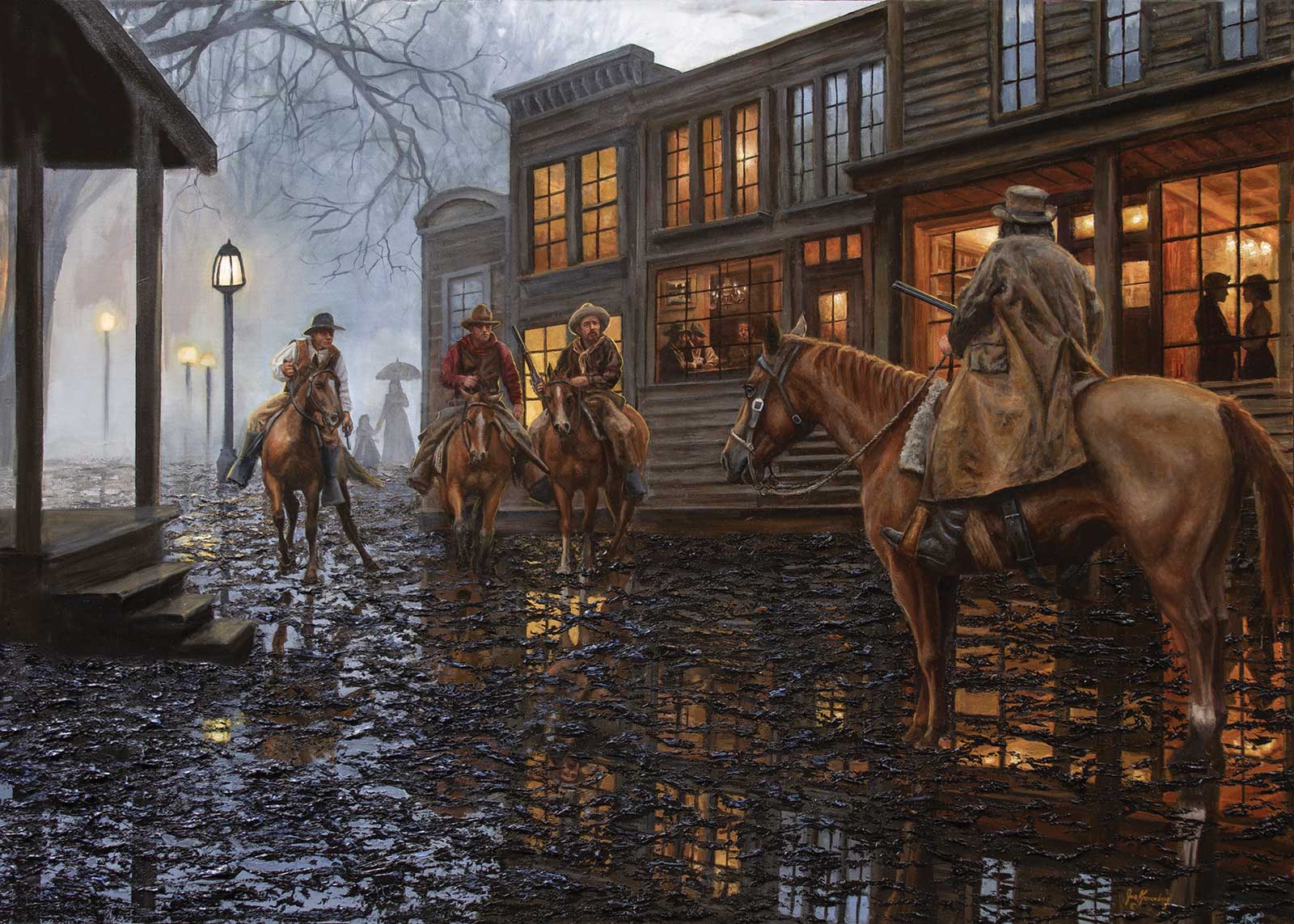
Hands, oil on panel, 34 x 48 in.
Rembrandt
OK, what about the 17th-century Dutch painter, Rembrandt? Well, this is where it gets interesting. Again, this has to do with light and how it’s presented by the artist. Kronenberg explains that few Western or wildlife painters use a technique perfected by Rembrandt four centuries ago. But when connoisseurs and collectors walk into a gallery, art auction or art exhibit, the time and effort the artist has put into incorporating Rembrandt’s methods sets his work apart.He suggests there are a lesser number in the genre of Western and wildlife art who invest the time it takes to understand and practice what Rembrandt perfected, such as opaque and transparent layering using oils. Unlike acrylic or watercolor, when using oil paints a full day of dry time is required between each layer of glazing. And to get the desired effect with oil, several transparent layers are needed, which means several days are required to complete a painting.
Kronenberg explains that we live in a world where instant gratification is the mantra, and artists often choose the alla-prima method, where color is applied directly over wet paint. With this method, paintings can quickly be completed. Not so with Kronenberg.
Rembrandt discovered he could get light to penetrate transparent layers, reflect off the opaque pigment, and bounce back through the transparent layer to give the painting a unique lighting effect. This is one reason his oil paintings set themselves apart.
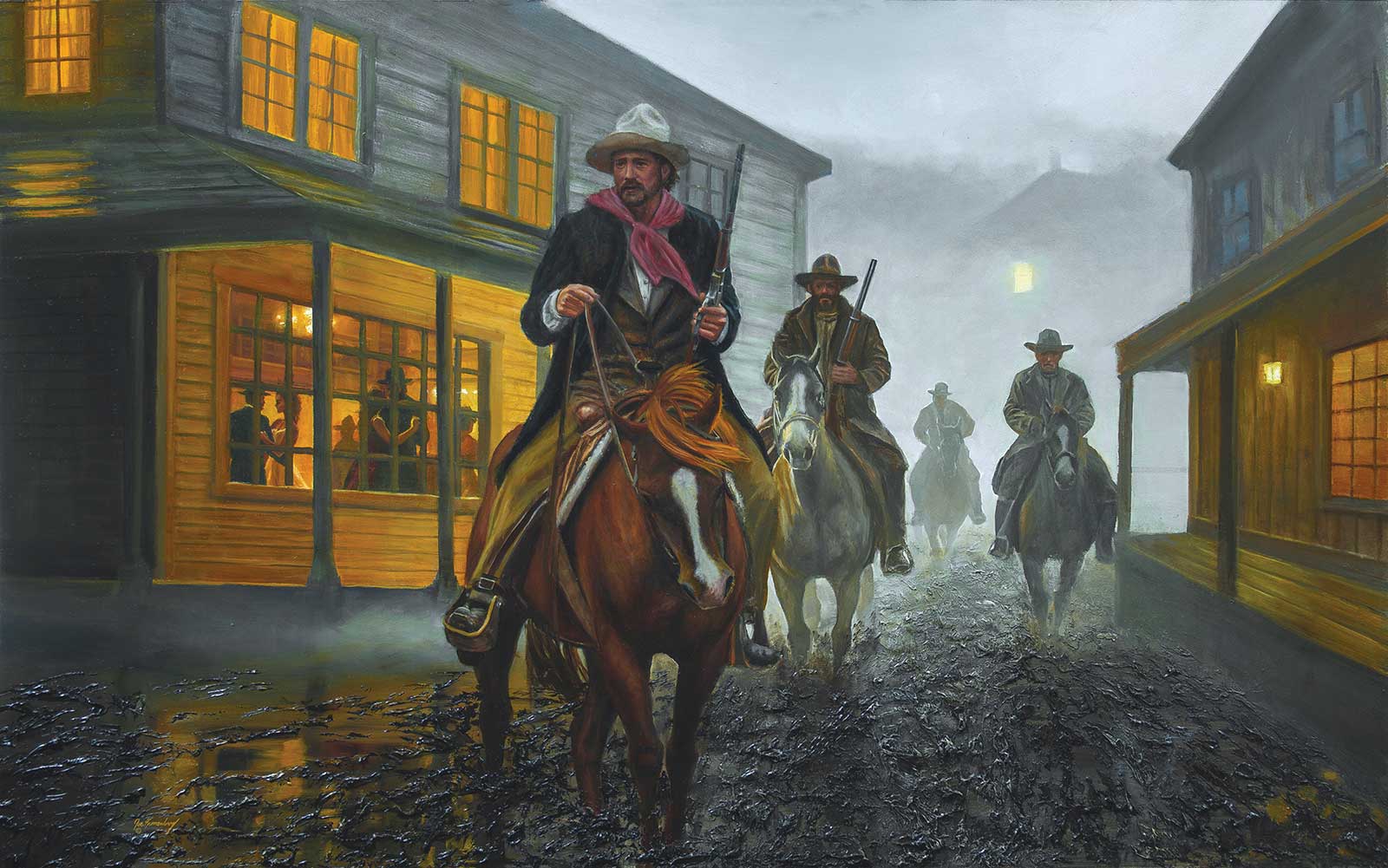
Dance Partners, oil
In Kronenberg’s paintings Hands and Dance Partners, among others, the skills he acquired during his deep dive into Rembrandt give the mud that is covering the street of this frontier town a look collectors have come to laud as “belonging to Joe.” With opaque and transparent layering, the painter takes the clumps of mud and makes them look like miniature waves on the ocean.
Closure
Saying goodbye to my old friend’s dad, a circle had been closed that for many years had remained wide open. As we shook hands, the artist smiled. It was around his eyes, especially his eyes, that I could see the same smile his father wore when we were young men, so many years ago. —
See More: www.kronenbergart.net
Powered by Froala Editor


